
Cape Cod Boating for Homeowners: Moorings, Marinas, and What the Listing Won't Tell You
In my experience helping buyers navigate waterfront purchases from Falmouth Harbor to Stage Harbor in Chatham, the single most expensive assumption I see is this: the dock comes with the house. It often does not — at least not legally, not operationally, and not without years on a waitlist. This guide exists to close that information gap before closing day.
Will You Actually Be Able to Use a Mooring — and How Soon?
Municipal mooring fields on Cape Cod operate on waitlists that commonly run 8 to 15 years for protected anchorages. Applying to multiple town lists simultaneously, beginning January 1st, is the only rational mitigation strategy for buyers who don't already hold a permit.
The waitlist reality breaks down roughly by geography. Exposed or tidal locations like Cotuit Bay or Taylor's Pond in Barnstable run 1–3 years. Mid-tier protected anchorages average 8–10 years. High-demand harbors — Ryder's Cove and Barn Hill Pond in Chatham — can exceed 12 to 15 years. If you are buying a home in Chatham or Orleans with the specific intent of keeping a vessel within rowing distance, you should be on the list before you close.
The application window is narrow: most towns require initial waitlist applications and a $10–$30 fee to be submitted between January 1st and March 15th or March 31st. Missing that window means losing an entire year of seniority.
| Municipality | Waitlist Fee | Renewal Deadline | Transferability | Removal Deadline | Inspection Interval |
|---|---|---|---|---|---|
| Barnstable | $25 | Annual | Immediate family only ($50 fee) | N/A | Every 3 years |
| Chatham | $25 | Dec 31 | Non-transferable (2-year non-use rule) | N/A | Every 3 years |
| Falmouth | $25 | Mar 15 | Direct family only ($100 fee; siblings excluded) | N/A | Every 3 years |
| Orleans | $10 | Mar 31 | Non-transferable (renters excluded) | Nov 15 | Annual |
| Yarmouth | $30 | Apr 15 | Non-transferable | N/A | Every 2 years |
Does a Mooring Transfer When You Buy the House?
No. Municipal mooring permits on Cape Cod are strictly non-transferable to property buyers and revert to the town's waitlist queue upon sale. Sellers cannot convey a mooring location as part of a real estate transaction.
This is the single most consequential piece of information missing from waterfront listings on Zillow, Redfin, and Realtor.com. A permit held by the seller for 12 years disappears at closing. The buyer starts at the bottom of the queue. Even within family transfers, the rules are narrow: Falmouth allows direct transfers to spouses, parents, sons, and daughters — but explicitly excludes siblings. A transfer to a sibling in Falmouth is denied regardless of circumstance. Chatham's non-use rule adds another layer: if a permit holder doesn't own a vessel requiring a mooring for two consecutive seasons, the location is automatically reassigned.
If you are currently under contract on a Cape Cod waterfront home and the seller holds a municipal mooring permit, I encourage you to verify directly with the local Harbormaster's office what happens to that permit at the deed transfer. See our waterfront property due diligence checklist for the questions to ask before you close.
What Is "Deeded Dock Rights" — and When Is It a Red Flag?
A listing advertising "deeded dock rights" is only as valuable as the active Chapter 91 license behind it. If that license is expired, the dock is unpermitted, and its removal can be ordered by MassDEP regardless of what the deed says.
Chapter 91 licenses — issued by the Massachusetts Department of Environmental Protection under the Public Waterfront Act — govern all private docks and piers on tidal or navigable waters. A Simplified License (for residential docks under 600 square feet) runs 15 years. A General License runs 30 years. Both require the physical structure to match the permitted footprint exactly. Any unpermitted extension, float addition, or gangway reconfiguration creates a structural liability that transfers directly to the buyer.
In my practice, I request a copy of the original Chapter 91 license, the stamped as-built plan, and the issuance date during every waterfront transaction. If the license has fewer than five years remaining, we negotiate for either a renewal prior to closing or a price concession that reflects the cost of renewal — which includes environmental review, Conservation Commission approval, and potential Army Corps of Engineers coordination. That process routinely takes 6 to 12 months.
Learn more about Chapter 91 license requirements for Cape Cod homeowners.
Section 10A vs. Chapter 91: Which Dock Permit Do You Need?
A seasonal, bottom-anchored floating dock can be authorized quickly through a local Harbormaster's Section 10A permit. A permanent, pile-supported pier requires a full Chapter 91 license from the state — a process that takes 6 to 12 months minimum and costs significantly more.
The practical distinction: Section 10A authorizes seasonal, bottom-anchored floats, rafts, and moorings. The structure must be removed from the water before winter. It bypasses the MassDEP state licensing process entirely and is issued at the local level. This pathway is ideal for homeowners who want temporary water access without committing to the capital cost and permitting timeline of a permanent dock.
Permanent piles — the posts driven into the seabed to support a fixed pier — require Chapter 91 General or Simplified licensing, local Conservation Commission approval, and in some cases Army Corps review under Section 404 of the Clean Water Act if the project affects navigable waters or wetlands. Presence of eelgrass near the proposed footprint virtually guarantees a more intensive review and possible denial.
How Deep Is the Water — and Does Your Boat Actually Fit?
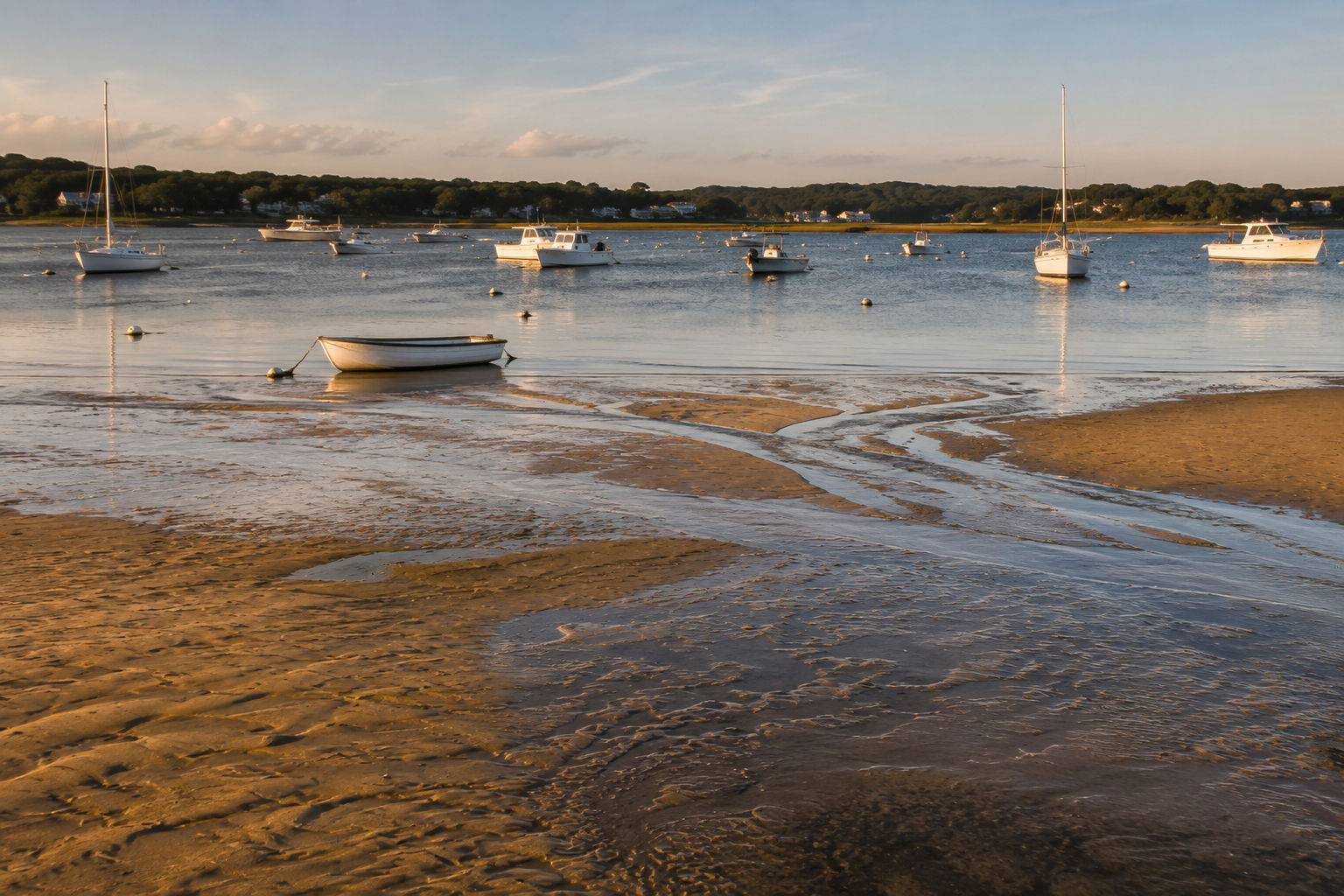
In highly dynamic inlet systems like Stage Harbor and Nauset Harbor, channel depths at Mean Low Water (MLW) can shoal enough to restrict vessels drawing more than 4 feet to high-tide navigation windows only. Buying a deep-draft vessel for use in these systems without verifying current NOAA chart soundings is a common and expensive mistake.
Chatham's Stage Harbor Federal Navigation Project entrance channel requires annual maintenance dredging — typically 40,000 to 60,000 cubic yards removed by a U.S. Army Corps hopper dredge each spring — because shoaling is continuous. Chatham secured a 10-year comprehensive dredging permit renewal in March 2026, which is a positive signal for boating homeowners in that market. Bass River in Yarmouth and Nauset Harbor in Orleans are similarly dynamic.
Before purchasing a vessel intended for use from a Cape Cod property, I recommend: (1) pulling the current NOAA Nautical Chart for the specific inlet, (2) verifying the most recent dredging survey date with the town Harbormaster, and (3) checking whether the channel is on the USACE active maintenance dredging schedule. A vessel drawing 5 feet may be fully functional in Falmouth's Quissett Harbor and largely stranded in Chatham's Stage Harbor except at high tide. See our Chatham waterfront market overview for more on harbor-specific considerations.
What Will You Pay in Massachusetts Boat Excise Tax?
Massachusetts assesses a flat vessel excise tax of $10.00 per $1,000 of state-mandated valuation under MGL Chapter 60B. Valuation is determined entirely by the centerline length and age of the vessel — local assessors cannot deviate from the statutory table.
As a practical example: a 32-foot vessel that is 3 years old carries a statutory valuation of $18,500, producing an annual excise tax of $185. The same vessel at 7 years old drops to a $9,300 valuation and a $93 annual bill. The minimum assessment is $5 regardless of vessel age or size.
An important compliance point for part-time residents: under MGL Chapter 60B, any vessel berthed on Commonwealth waters for more than two consecutive weeks must obtain a local mooring or waterways permit and is subject to the boat excise tax in the town where it is situated. Registering a vessel in another state to avoid Massachusetts taxation does not exempt the owner from excise liability if the boat is physically located in a Cape Cod harbor for more than two weeks.
| Vessel Length (Feet) | Under 4 Years ($) | 4–6 Years ($) | 7+ Years ($) | Annual Tax (7+ Yrs) |
|---|---|---|---|---|
| Under 16' | $1,000 | $700 | $400 | $4 |
| 20' to <22.5' | $5,000 | $3,300 | $2,500 | $25 |
| 25' to <27.5' | $10,500 | $7,000 | $5,300 | $53 |
| 30' to <35' | $18,500 | $12,300 | $9,300 | $93 |
| 40' to <50' | $31,500 | $21,000 | $15,800 | $158 |
| 60' or Over | $50,000 | $33,000 | $24,800 | $248 |
Navigating the Cape Cod Canal: What Recreational Boaters Must Know
All recreational vessels transiting the Cape Cod Canal must operate under power — sailing vessels may not transit under sail alone. The speed limit is 10 mph (8.7 knots) over ground, and the current inside the canal can reach 6 knots, making timing relative to the tidal cycle a safety-critical decision.
Federal regulations require all radio-equipped vessels to maintain a continuous listening watch on VHF Channel 13 throughout the passage. Vessels transiting with the current have right of way over those transiting against it. Stopping, anchoring, and trolling are strictly prohibited within the canal limits. Swimming, snorkeling, and scuba diving are also prohibited. For vessels under 65 feet, stay to the right-hand side of the channel and do not impede commercial traffic — the Bourne and Sagamore Bridges see cargo and tanker traffic that cannot maneuver in the narrow channel.
One infrastructure note relevant to every Cape-side property buyer: the Sagamore Bridge replacement project is on schedule to begin construction in winter 2027–2028, with MassDOT securing final state environmental certificates in April 2026. The project is expected to run through 2037. MassDOT has committed to maintaining two lanes of traffic in each direction throughout construction, but localized lane closures on the Bourne Bridge — whose replacement remains unfunded — will continue as the Army Corps performs maintenance work in 2026. Buyers commuting from the Mid-Cape to Boston via Route 6 should factor this into their operational calculus. See our guide to Cape Cod commute corridors.
Wet Slip vs. Mooring: Which Is Right for Your Situation?
Wet slips offer immediate, walk-on access with dockside power but cost $125–$375 per foot seasonally and require advance booking. Mooring fields are dramatically cheaper but may require a decade-long waitlist, offer no shore power, and require a dinghy or water taxi to board the vessel.
For buyers with mobility considerations, guests who board frequently, or vessels over 35 feet, the wet slip premium is typically worth it. For buyers with smaller vessels, patience for a waitlist, and genuine desire for the authentic Cape Cod anchorage experience, a mooring field is the correct long-term solution — provided you apply early and understand that the permit does not travel with the deed. Private mooring rentals through commercial boatyards (Chatham boatyards charge $1,200–$3,000 per season) offer a middle path to bypass the municipal waitlist, though the Massachusetts Inspector General has questioned the legal basis for private entities sub-leasing spaces authorized under public waterway permits — making these arrangements potentially vulnerable to regulatory change.
Compare wet slip and mooring costs across Cape Cod marinas.
Choosing the Right Mooring Tackle for Cape Cod Seabeds
For sandy, high-current inlet seabeds, a Dor-Mor pyramid anchor outperforms a traditional mushroom anchor at equivalent or lower weight because its wedge geometry penetrates hard-packed bottoms rapidly. Mushroom anchors depend on slow burial in soft mud to achieve holding capacity — they underperform in dynamic, sandy environments.
| Boat Length | Mushroom Anchor (lbs) | Dor-Mor Anchor (lbs) | Top Chain | Pennant |
|---|---|---|---|---|
| Up to 13' | 100 | 70 | 3/8" | 1/2" |
| 20' to 25' | 200+ | 200 | 1/2" | 5/8" |
| 26' to 29' | 300+ (plus 75 shaft) | 375+ | 1/2" | 5/8" |
| 30' to 39' | 500+ (plus 75 shaft) | 500 | 5/8" | 3/4" or 2@5/8" |
| Over 40' | 700–1,000 | 1,000 | 5/8" | 1" |
Seasonal Storage and Winter Compliance
Many Cape Cod towns restrict the parking of large boat trailers on residential lots during winter months, and popular commercial storage facilities — including Sandwich Marina — require all boats to depart by May 15th annually. Planning for winter storage is not optional; it is a cost and logistical obligation that must be budgeted before purchase.
In Orleans, all private moorings and tenders must be completely removed from town waters by November 15th. Failure to comply results in a $50 fine and a one-year suspension of mooring privileges. Yarmouth requires mooring tackle inspection every two years by a certified installer; failure to submit the certified inspection report to the Natural Resources Office results in immediate permit cancellation. These are not formalities — they are active enforcement mechanisms.
Download our seasonal maritime compliance checklist for Cape Cod homeowners.
Applying for a Mooring Permit as a Part-Time Cape Homeowner
Property tax payers on Cape Cod who maintain their primary legal residence elsewhere may still qualify for resident-rate mooring permits or placement on the faster resident waitlist in several towns — because many town charters define "resident" to include local property taxpayers. This is a meaningful advantage that many seasonal buyers overlook when they self-classify as non-residents.
Verify directly with each town's Harbormaster whether property tax payment alone qualifies you for resident permit status. In several municipalities, the answer is yes — and the difference in waitlist velocity can be measured in years. Contact our office for a town-specific mooring eligibility review.
Categories
Recent Posts
GET MORE INFORMATION